From The Stories Issue
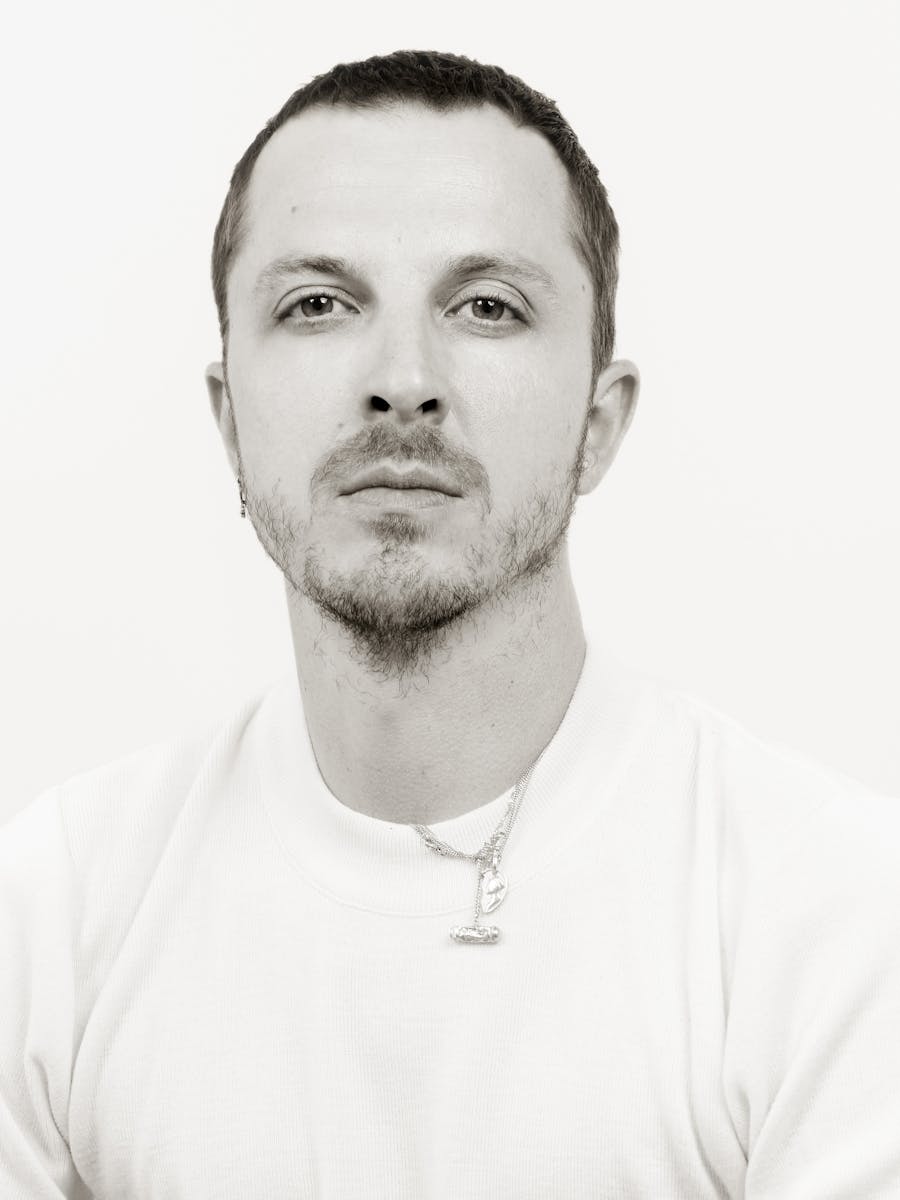
For more than four decades, Belgian make-up artist Inge Grognard has been challenging beauty with her subversive approach to the face. Part of the Antwerp Six’s rise alongside Martin Margiela, she has since worked with Demna Gvasalia, Christian Wijnants, Haider Ackermann and A.F. Vandevorst, among many others. Cigarette between her fingers, she smiles at her longtime friend, Belgian architect Glenn Sestig, who takes her back through the creative worlds they have shared ever since. No nostalgia. Just the pleasure of revisiting the good years, and wondering what remains when the rules have changed.
INGE GROGNARD I remember running into you in one of your first apartments in Ghent. There was a lot of laughing. I also remember you having a discotheque, or a club?
GLENN SESTIG Culture Club, in Ghent! I designed it. And there were also the Belmondo parties. We would meet at my apartment and head to the club afterwards. That’s a long time ago!
I.G. It was amazing at the time. We went out almost every week. I remember the street around my corner, where all the gay bars were. People were dressed up. It was fashion. Everybody was dancing on the tables. Nightlife brought everyone together. That’s how I met so many people I still know today.
G.S. In the early ‘80s, Antwerp was becoming the centre of a very singular creative pulse. What made that energy so fertile?
I.G. It was the right place at the right moment. People came from all over Belgium, and abroad. The size of the city was also important. In a way, Antwerp is a village. Ghent too. Everybody knows each other. And when there are a few good clubs and bars, you keep seeing the same people.
G.S. It reminds me of studying architecture at the Royal Academy of Fine Arts in Antwerp. Everything was mixed back then: fashion, photography, painting, sculpture… I always ended up going out with the fashion people. I preferred the sense of wildness they had.
I.G. Such a small world.
G.S. And we support each other.
I.G. Until the end of my life!
G.S. With all these creative fields flourishing around you, what drew you to fashion?
I.G. I was already interested in fashion when I was 12. My parents weren’t really into it, but I met Martin Margiela when I was 14. I’ve always felt it was about more than clothes. It’s everything around you: the flowers you put in your house, the second-hand furniture you buy when you don’t have much money… It’s all part of a certain aesthetic you’re drawn to. In the end, all the people we have in common are creative.
G.S. And we’ve both worked with some of them for years. What makes a collaboration last?
I.G. You have to stay open. Open to discussion. You’re not always right, so you have to be tolerant towards each other. And then there’s trust, staying loyal to yourself, but also to the people you’ve known for a long time. That’s why I’ve worked with Martin Margiela for 20 years, and with Demna at Balenciaga for 10. At a certain point, you know each other’s tastes. Sometimes you only need two words or a piece of music to get into the feeling of a season and put your own stamp on it.
G.S. Exactly. I try to give shape to what people struggle to express. They know what they like,but they don't always know how to translate it into a space.
I.G. And I’d recognise one of your pieces anywhere.
G.S. That’s the thing. We both have a signature.
I.G. That was the goal from the beginning.
G.S. But it was never the reason. It just happens. That’s where our disciplines meet. Do you feel architecture relates to space the way make-up relates to the face?
I.G. When I do make-up on a face, I can take it away in a minute. With architecture, it’s harder to change. That’s the big difference. But sometimes make-up lasts for decades through a picture. Then they use that word I hate: iconic.
G.S. We both rely on precision and proportion, but the unexpected always finds its way in. How much room do you leave for it?
I.G. I start with one question: what do I want to tell? There’s always a message. Then I make a moodboard and look for the right faces. Once we’re in the studio, I can improvise. I talk to people, see how they react, how they open and close their eyes, how they feel. Then I adapt the idea to the face. Because an idea can be wild, but if it doesn’t work on the face, it’s lost. I didn’t pay enough attention to that when I was younger.
G.S. What does touch reveal that sight cannot?
I.G. It’s more about the texture of the products I use. I think that’s one of the biggest evolutions we’ve seen in makeup. But touch goes beyond make-up. It’s everything I buy: clothes, furniture, whatever. I have to see it. I have to feel it. It’s the same with products. I test everything on my own face. If I can feel it, I can stand it. I’m still very much for the real stuff. I’m interested in AI, but I need to see, feel, smell.
G.S. AI is already changing the way beauty is made. How do you navigate that?
I.G. When Photoshop first came out, we were scared of losing our jobs. But the need for human creativity holds. AI is moving very fast, though I still believe in handcraft.
G.S. What we both do is craftsmanship. Even when it’s not done with our hands, it’s done with our heads. We design things that come from within us
I.G. Otherwise, it’s missing a soul. I hope people realise that we need a balance. But I still have faith in creativity. Let’s wait and see!
G.S. Do you miss the freedom we had in the ‘80s?
I.G. Back then, there was no social media. You had to do things. Sometimes people saw them, sometimes they didn’t. The freedom we had, and the time we had to develop, doesn’t exist anymore. But when you’re strong enough and believe in yourself, you can still take that freedom. I always did. And my freedom is unpayable. After 45 years, I’ve stayed loyal to that. It was a slow road, with ups and downs, also money-wise. But I don’t regret anything. I would do exactly the same. Everyone I really wanted to work with, I did. And I’m not into famous people. Totally not. I want interesting faces, good designers. People whose collections I like, that I feel something about. Good people.
G.S. And after all these years, how would you define beauty?
I.G. I can’t. Beauty has always felt a little off. There’s beauty in so many things. The ugly can be beautiful.
G.S. Above all, beauty is personal.
I.G. And let’s keep it that way!
Conversation between Glenn Sestig and Inge Grognard, by Jana Masmoudi-Pavanello

Work in progress by INGE GROGNARD