From the Room Issue
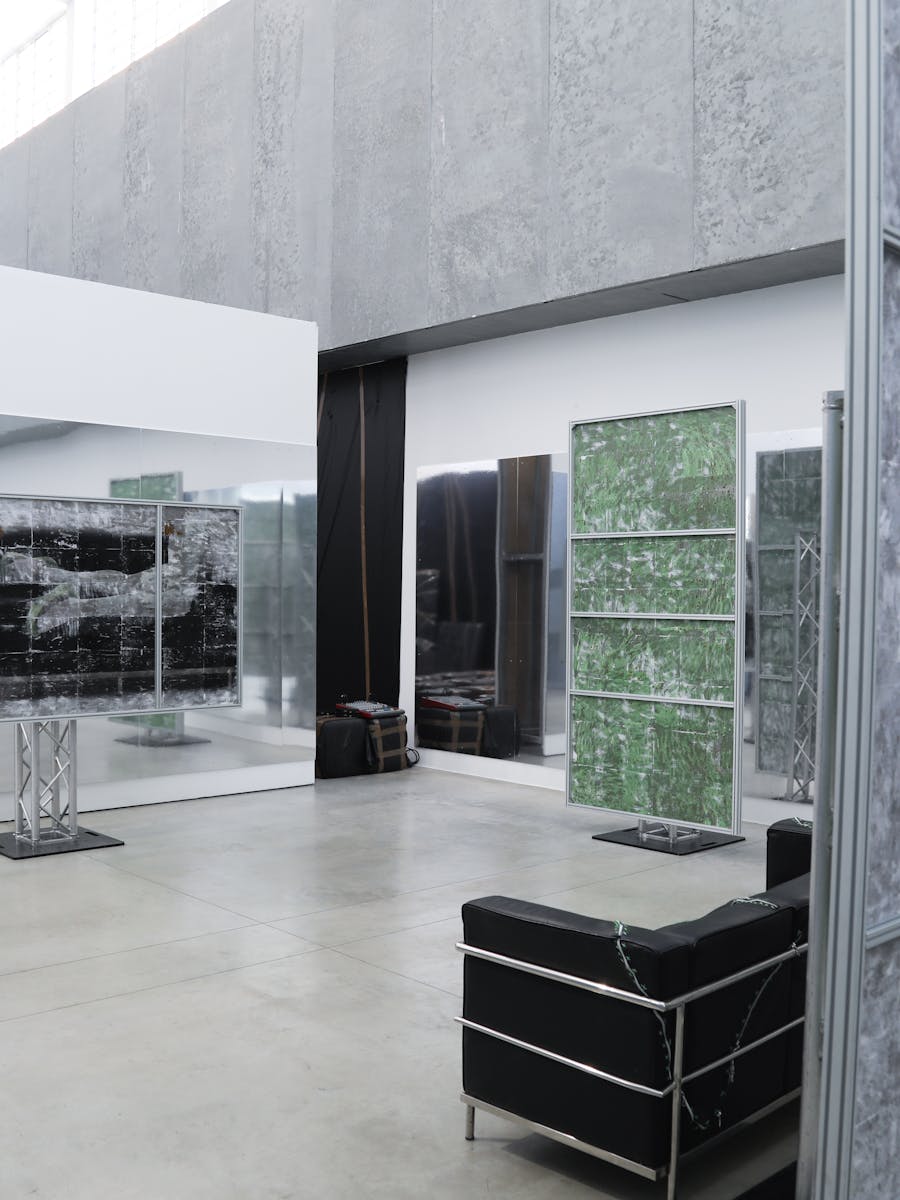
Some artists enter a room and you notice the temperature change. Her work has that quiet authority: rigorous, tender, and attentive to the social life of a space. This interview begins with a simple prompt and opens onto a practice shaped by friendship, craft, and sustained attention. Ongoing, her evolving exhibition built around eight collaborations, turns biography into a shared atmosphere, where objects, images, and live presence rewrite one another. After its presentation at the Eye Filmmuseum in Amsterdam, the show will unfold in Athens from mid-May, at Onassis Ready, the Foundation’s new venue for experimentation. What follows is a conversation about how trust is forged, how time becomes porous, and how hospitality can function as a method, a boundary, and a promise for us all.

Tilda Swinton performing The Maybe, Serpentine Gallery, London, 1995. Photo: © Hugo Glendinning

Tilda Swinton with Olivier Saillard and Gaël Mamine working on A Biographical Wardrobe performance, Scotland, 2024. Photographed by Ruediger Glatz, courtesy Olivier Saillard and Tilda Swinton © Ruediger Glatz

Tilda Swinton in Eye Filmmuseum, Amsterdam. Photo by Victor Wennekes, courtesy Eye Filmmuseum.
When you hear the word “room,” what do you picture first ?
TILDA SWINTON I think of a room in a house. Light. Low windows. A wooden floor. A clear, friendly space.
What does your ideal working room need ?
T.S. A view of trees, preferably treetops. A window seat. An open desk. A mantelpiece and a fireplace. Dogs.
If your body were a house, which room would you spend the most time in ?
T.S. The garden.
What’s a daily ritual that helps you reset ?
T.S. Walking, especially by the sea. Time with trees.
In your own words, what is Ongoing ?
T.S. It’s a self-portrait of a young person finding her way into an artistic practice through her earliest close working relationships. It’s an invitation to reflect on the modesty and endurance of complicity and collaborative friendship, its energy, and its reliable, sustainable joy. It’s about process, not product, and its material gestures manifest living, ongoing conversations between us. In that sense, it’s always a work in progress: a witness to a living collaborative practice, and a project that will keep shifting as it travels over the coming years.The exhibition is built through eight long-term collaborations.
What makes a collaboration last ?
T.S. Trust, kindness, mutual respect, shared vision, a sense of adventure, dedication to fresh horizons, curiosity, fun.
What’s your relationship with time ?
T.S. Pretty relaxed. Porous. I’m intrigued by its rhythms and repetitions, its developments and evolutions. Sometimes I struggle to believe it exists at all, given the tidal waves of consistency and an essential pulse.
What is truly ongoing ?
T.S. Fellowship. Nature. Art.
What do you hope the Athens presentation at Onassis Ready brings out differently from Amsterdam ?
T.S. Most importantly, a new audience. This is the first time we’re traveling with a piece designed not only to move, but to develop and change. Ongoing is both the subject and the form of the show.
What can a performer bring to an exhibition space that an object alone cannot ?
T.S. I’m not sure the difference is absolute. In both cases, the spectator’s response brings the charge: context and exchange of energy. Maybe it’s free will and unpredictable impulse on both sides that create the surface tension in a room. With an inanimate object, the spectator carries more of that generation. With other human presence(s), the atmosphere is made between us. It’s always co-created with the audience.
In Ongoing, artists like Tim Walker and Joanna Hogg translate parts of your life, home, memory into their own language. What do you recognize, and what do you gladly lose control of ?
T.S. These collaborations, and the relationships they spring from, are rooted in confidence and shared vision. Each piece was made in close partnership. The “own language” of each of my fellows is one I know well and have worked with before. I invited each of them because I trusted they’d bring their particular aesthetic and responsive selves into this highly personal autobiographical territory. What we made, in every case, was what I’d hoped for : authentic impulses met with faith. It was beautiful to walk through these passages of my life with beloved friends.
What does hospitality mean in your practice, and where do you draw the line between openness and protection ?
T.S. Hospitality is a core value in my life, and key to my practice. An inviting, receptive atmosphere matters not only for the audience, but for the making of the work itself. I came to feel that one step toward dissolving the societal disease of inequality and exclusivity, even tyranny, is the proactive establishment of a comprehensive democracy of spirit. That asks for mutual respect and openness, taken on by each of us in service of transforming our environment. I still believe this is our best hope : trust, while respecting our own needs and boundaries, as we respect those of others. That means cultivating unguarded honesty and reciprocal exchange of space, while staying attentive to what each of us requires.
In A Biographical Wardrobe, you and Olivier Saillard bring your wardrobe to life as a performance. What can clothing reveal that speech cannot ?
T.S. I grew up in a family not used to discursive reflection, so I learned early to value what clothes can communicate. My mother’s choices before going out, the dazzle of my father’s military uniforms, what I was encouraged or discouraged from wearing, and how differently I felt depending on what I wore. Since 2012, working with Olivier, whose knowledge and sensitivity around the signs and meanings of clothes is unparalleled, has deepened that interest. Clothes tell stories. We rely on them to hold narratives we choose, but maybe can’t express in other ways. They signal how we want to be seen, approached, and treated, whether we admit it or not. They’re a conduit for socialisation, beyond keeping us warm or comfortable. Looking closely at the clothes we value and rest ourselves upon, the tendencies we repeat, the influences we absorb, and why, is a worthwhile endeavour. I highly recommend it.
How did you decide what belongs in that wardrobe, and what must stay out ?
T.S. Olivier and I worked through hundreds of pieces. Choosing each one was laborious and deeply intuitive. Now that the selection is made, it’s hard to imagine it being different. Each part somehow unlocks the inclusion of the next. My family’s christening robe, for example, or my father’s prosthetic leg, both also included in Tim Walker’s portfolio, once unearthed, became anchors that grounded the work in the personal. Everything else was tested for resonance and connection. The presentation we make here is profoundly sincere, vulnerable, and open-hearted.
Looking forward, what kinds of “rooms” do you want to create next ?
T.S. More spaces, in all sorts of environments, for engagement and wonder, for company, and for encouragement toward reflection and transformation. And a paramount celebration of human spirit, connection, and joy.

Pedro Almodóvar, The Human Voice, 2020 30 min, sound Courtesy El Deseo en Cineárt

Derek Jarman, The Last of England, 1987 (fragment) Courtesy Tigon Film Distributors

Derek Jarman, Timeslip, 1988/2025, Super8 transferred to video, 4 min., 9.07 min., Filmed in Dungeness, Kent, by Derek Jarman Courtesy Basilisk Communications Limited, with thanks to BFI National Archive

Still from Apichatpong Weerasethakul’s double-channel video installation Phantoms, 2025. Commissioned by Eye Filmmuseum, co-produced by Onassis Stegi. © Apichatpong Weerasethakul, Kick the Machine

Still from Luca Guadagnino’s Camaraderie, 2025. Commissioned by Eye Filmmuseum, co-produced by Onassis Stegi. © Luca Guadagnino