From The Stories Issue
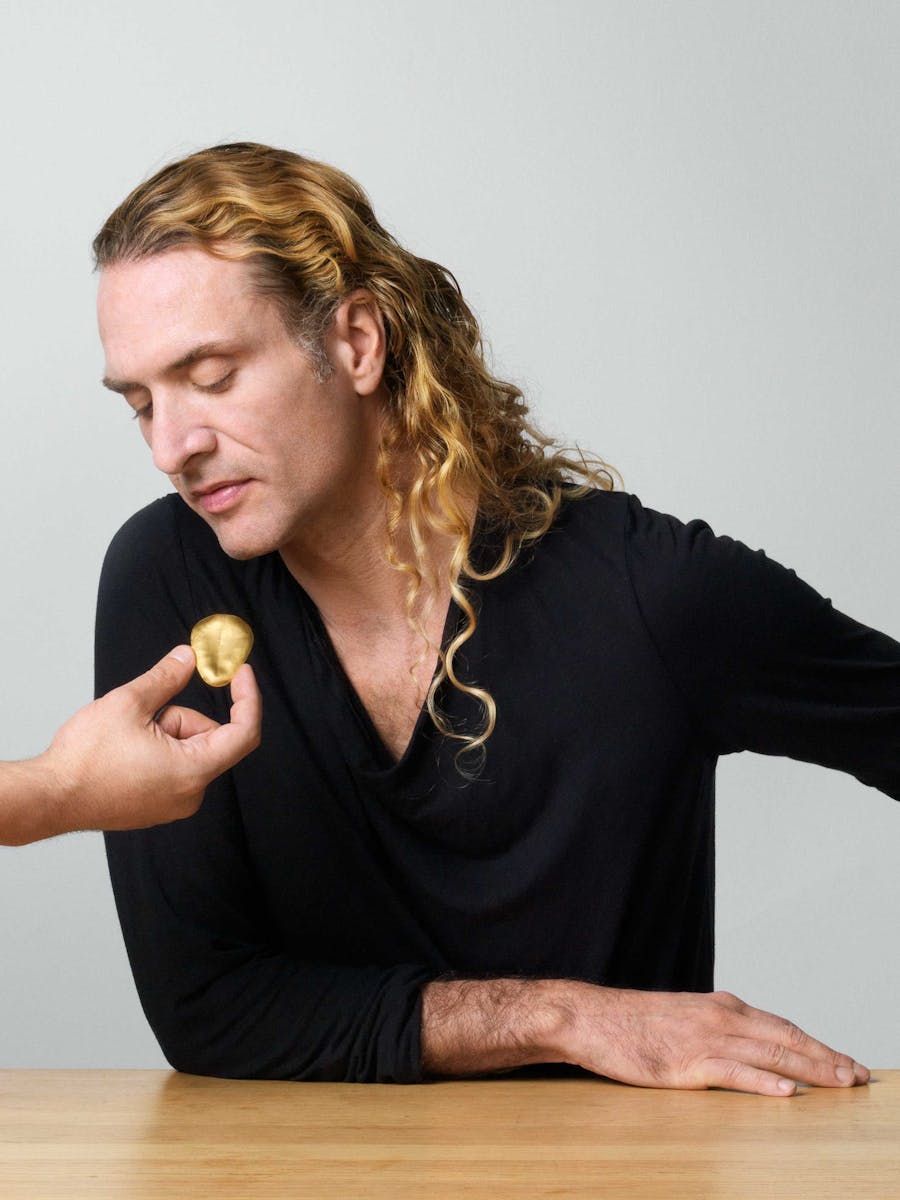
Art historian, curator and artist Emmanuelle Luciani builds worlds. Born in Marseille, she founded there the Pavillon Southway, a hybrid space somewhere between gallery, residency and guesthouse. In her work, she blends high art and popular culture, probing the frictions between art and decorative arts, between memory and modernity. Artistic director of the Fondation Hermès's 2024-2025 residency program, she continues to develop, in Marseille, an immersive practice in which dance, rap, car tuning and art history speak to one another.
Tell me about your path, and the place of Marseille in your story.
EMMANUELLE LUCIANI I started classical dance at three. Very early on, I understood that this training belonged to a kind of total art: costume, music, movement, set all formed one global language. That structured me deeply and continues to inform
my practice.
I entered the Beaux-Arts young, maybe too young, since I got my baccalauréat early. I quickly felt the need for a more theoretical education, so I studied art history in parallel. I needed it, to be nourished in a different way, and to get out of the ultra-contemporary. Art history is, for me, a critical tool: it lets you step back from the present. Marseille, in all this, is absolutely decisive: it's the starting point of my inner operating system. I grew up in a city where the usual hierarchies matter less than the circulation of forms, cultures, imaginaries. There, a symbol could carry as much weight as a museum. Very early on, I needed everything to rub against everything else: sport and elitism, the popular and the learned, the decorative and the conceptual. I'm not after purity; what interests me is mixture, friction, impurity. And coming from a city with 2,600 years of history changes your relationship to time. You don't glimpse modernity the same way. You develop a sidestep, another scale for reading the present.

You work at the crossroads of several worlds — popular culture, classical culture, art, sport, history. Is that a difficult position to hold?
E.L. Yes, very: hybridity is complex to bring into being, because our era likes to categorize, to fix, to repeat. For me, being an artist doesn't mean endlessly reproducing a form: it means generating research, and so accepting permanent mutation. That mobility is easier to live with internally than to get recognized by the market or by institutions. The market loves repetition, legible identities, stabilized forms. I need research to stay alive, to keep dialoguing endlessly with history and the present. It's a position that takes longer to establish, more fragile. But I believe it's necessary: it keeps art from being reduced to a logic of style or signature.
What is the Pavillon Southway? Why did you launch it?
E.L. The Pavillon Southway was born of a concrete need: to create a lasting tool, a place that wouldn't be merely temporary. After a lot of exhibiting, a lot of theorizing, I wanted to found something solid, blending work, hospitality and a circular economy. I found a house and turned it into a pavilion where you can work, stay, host visitors, rent out rooms.
I wanted to invent another way of thinking about the decorative arts, no longer as a mere exhibition object, but as a lived experience. The project took shape during Covid, at a moment when I no longer believed in traditional residencies, nor in a certain form of cultural welfare state. I wanted a place that welcomes, that connects, that circulates people and ideas — a space where creation is genuinely inhabited.
You collect a lot of objects. What makes you keep an object?
E.L. I collect technical objects, mechanical parts, car components, pipes: modest things. They're not objects of great value, but I look at them as archaeologies. There's something political in that. I love the automobile for its pop dimension: an object that could cost billions but that, mass-produced, becomes accessible. I love independent garages, scrapyards, repairmen, those who bring back to life what seemed condemned. It's a form of quiet resistance, a way of escaping the logic of subscriptions and standardization. Repairing, recycling, bartering: all of that makes up a genuine popular ecology.
In your work, you often bring up science fiction. Where does that taste come from?
E.L. Science fiction helps me tear myself away from the present, from its injunctions, its assumed truths. It's a space where you can invent mythologies, create worlds, fabricate narratives that speak of the present differently. In that sense, I see it as a critical tool. What interests me in certain authors is their capacity to produce imaginaries that are also structures of thought. Tolkien or Philip K. Dick don't just tell stories: they build entire universes. I like a science fiction that's positive, run through with tension, with a possibility of opening onto other outcomes. I'm wary of narratives that are too closed off, too postapocalyptic and too quickly concluded.