From The Stories Issue
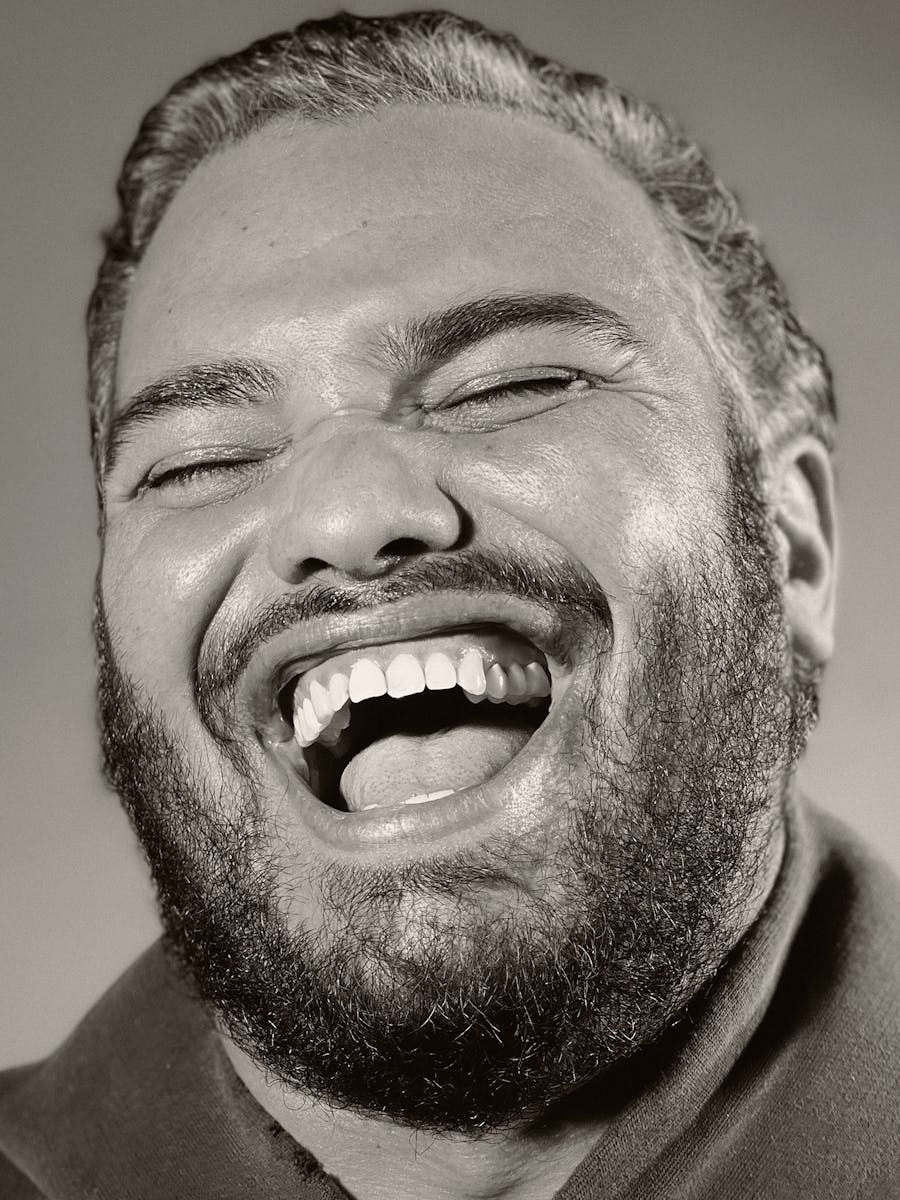
In the space of just a few months, the Dutch designer Duran Lantink has found himself brushing shoulders with the summits of Parisian fashion, with voluminous, conceptual collections, funny and insolent, and widely applauded. After a few months of rising under his own name, he set his own label aside in April 2025, in favor of another mission: becoming the first permanent artistic director of Jean Paul Gaultier to take over from the iconic founder, who has been retired since 2020. His first two ready-towear collections and his first foray into haute couture have revealed his taste for humor, distortion, a slightly seedy kind of seduction, and outright provocation. And an obvious desire to pay tribute to a great house's past, without fear or servility.
For your first show at Jean Paul Gaultier, you got a lot of people talking with a trompe-l'oeil bodysuit that revealed the body of a man, entirely nude. We could say, in the pages of Exhibition, that it was a pretty exhibitionist first step…
DURAN LANTINK Completely! And yet I don't think I'm an exhibitionist.
You even happily describe yourself as a voyeur…
DL Yes, I love observing, scrutinizing. In Paris, for that, there's nothing better than the bike lanes. I know I'm supposed to be watching the road, but on a bike, I love people-watching. On my way to work, on Rue Saint-Martin, I pass by Galeries Lafayette, where there's always a very well-dressed crowd to look at. Otherwise, sometimes I lean against a wall outside, listen to music and watch passersby. I particularly like old people, the most stylish of all. I'm obsessed with the chic of people in their seventies and eighties, men especially.
Has it ever happened that you came across your own clothes, worn by a stranger?
DL Not yet at JPG, since my collections have only just arrived in stores, but with my own label, Duran Lantink, it happened to me once or twice.
Seeing your work adopted by the street is
the ultimate goal for a designer, isn't it?
DL [Long silence.] Honestly, it depends who's wearing it!


That famous look with the realistic body of a naked man printed on it sparked an enormous amount of commentary, and not all of it positive. But I get the sense that being at the center of the conversation doesn't exactly displease you…
DL I'm not chasing bad comments either. That body, that hair, that dick, I obviously thought it would generate strong opinions, but I told myself: screw it, why should I stop myself from showing that? I didn't understand the sheer virulence of the reactions. Shouldn't we all be reviving that joyful, punk freedom of expression from the 1980s? I heard a lot of "that's not Gaultier." To my mind, that silhouette is very Gaultier, on the contrary: it asserts a freedom, a taste for experimentation, it demands that we stop stigmatizing things as weird.
Maybe it's the nudity itself that still unsettles us?
DL Yes. It's striking to see how much our era is reviving a certain conservatism. You see it at the ballot box. Which frightens me.
Do you think it's harder to propose avantgarde, out-of-the-box fashion today than it was in the 1970s and 1980s, when Gaultier was emerging on the Parisian scene?
DL Back in Monsieur Gaultier's day, the primary audience was the press, not a social network with 3 billion users where everyone is looking for some form of validation. Because people don't just comment on fashion for its design: through their comments, they're looking for a community. And by racking up "likes," they feel seen. And we know the algorithm gives more weight to negative comments. In that context, I try to stay focused, and above all curious. I want to create fashion pieces we haven't already seen.
In your first couture collection, in July, you put a lot of emphasis on this idea of inventing new, unseen forms…
DL Yes, I look for hybridity, I experiment. From Gaultier, people often remember the identified codes—the conical breasts, the sailor stripes—but the archives are insanely rich and endlessly inventive. Think of Jean Paul's asymmetrical suits, or his long-sleeved bonnets, my current obsession. He dreamed up complex pieces that were always tremendously fun—that's his genius. That said, I want to avoid referencing the archives too directly. Fashion has to be future-proof, not look like nostalgic vintage. To me, the archives are like Charlie and the Chocolate Factory: I want to open the doors to that wonderful world one by one, savoring each one. So I go step by step.

It's been a year now since you became artistic director of the house. You have regular lunches with Jean Paul Gaultier. What artists or works has he introduced you to?
DL The films The Night Porter with Charlotte Rampling, and The Holy Mountain by Alejandro Jodorowsky. We've also talked a lot about the Dune saga [by Frank Herbert]. In exchange, I introduce him to music, videos, restaurants. Like St. John in London, where he now goes often.
If Jean Paul didn't like one of your collections, would that be a big deal?
DL That would be terrible, of course! I literally never cry. But in that situation, I think I actually could cry. His opinion matters. At the end of the day, it's my interpretation, but it's his name. He has to be proud of it.
Since your beginnings, and now within his house, you've been redrawing bodies. Distorted bodies, degendered bodies, bodies augmented with appendages or growths… Are you comfortable in your own?
DL We already live in a world where plastic surgery makes anything possible. People get Brazilian butt lifts, breast implants, muscle implants… My work is a continuation of these explorations into the wardrobe.
Would you consider an operation for yourself?
DL I'm not against it. Maybe grow some horns? But that sounds painful, and I'm no hero! I don't think I'm ready yet.
In your fashion, this attention to the body goes hand in hand with the evocation of a joyful, liberating sexuality…
DL That's a fairly natural language for me. I was fourteen when I came out. I was on a terrace with friends and I first told them "I'm bisexual," to ease into it gently. They said back to me: "You're just gay!" I think, honestly, it was impossible not to notice—at the time, I was very queer, I wore Walter [van Beirendonck] shirts, a Vuitton bag fake-tagged with spray paint… So tacky!
That's also the year you organized your very first fashion show…
DL Yes, in Scheveningen, a seaside district of The Hague, at the beach club of some friends of my parents. I'd made a pleated denim miniskirt, sewn with a tartan print, which had become fairly popular among people I knew, and with the money from sales, I organized that show. My girl friends played the models, in ubiquitous floral print and flared trousers. I'd borrowed some Dolce & Gabbana heels that we then wrecked so thoroughly partying afterward that my parents had to pay for them. They were not happy!
That was twenty-four years ago now…
DL Wow! That's crazy. And to think people ask me today, "How did your career take off so fast?" Honestly, I'm the slow-blooming type.
Did the road to recognition feel long to you?
DL Not really, actually. I wanted to be noticed back in primary school, with my presentations on Dior, Chanel, Lacroix or Cardin. But during my teenage years, I didn't care about being liked. And in art school, I did things mostly for myself. It was really starting with my first show in Paris, in 2023, that I began to properly get caught up in the game of fashion. The show calendar, the magazine features…
And, eventually, the race for a top position at a major house…
DL Yes. The day they approached me about JPG, I thought about it and told myself: yes, I want to do this. It made sense. I wanted to grow, and to honor the love I've had for Gaultier since I was little.
To manage to establish yourself in this fashion landscape, did you have to lie a lot?
DL I've had to bluff probably a million times! When you're running an independent label, you have to bluff to get things moving, to see a production through, to find partners. Otherwise, how do you get by? When you don't have money, you have to win people's trust and get them excited. But I told the truth during the hiring process at JPG, I swear! And in the creative process, I don't cheat. To create collections, you have to hold yourself to artistic honesty.