There’s a lightness to Pauline Dujancourt’s work, in the way it moves, in the way it’s made. Her first collection began with a dying parakeet, found on a London pavement, brought home for what she assumed would be its last night. By morning, it was flying. It’s a habit of hers, taking what’s been written off and making it move again.
That same instinct runs through her knit and crochet. Behind every panel lie hours of labour, and that patience has anchored her label since its 2022 launch, from a finalist spot at the LVMH Prize to this year’s ANDAM Special Prize.
For the release of her latest collection at Dover Street Market Paris, Pauline Dujancourt opens up about memory, superstition, and the women behind every stitch.


Did you always want to become a fashion designer, or was there a defining moment when you knew this would be your path?
P.D. Not always, and not only. I wanted to be an actress first, and I loved fine arts too. I was lucky to have creative parents, and a mother who pushed me early on through piano, ballet, drawing, and drama classes. All of it fed a creative world I’d eventually translate into fashion. After school I studied fashion at École Duperré in Paris, taking drama classes in the evenings. Doing both meant I never had to choose between them outright. What actually settled it was an internship in London: working in a studio, assisting at fittings, then backstage at my first London Fashion Week show. That experience made the decision for me. I also just loved the city. I finished my degree and moved there permanently a few months later.
If you hadn’t become a fashion designer, what career do you think you would have pursued?
P.D. Theatre, without question. I loved being on stage, stepping into character, feeling emotions that weren’t mine, believing for a moment I was someone else. I was also drawn to directing, lighting, sound, movement, the whole architecture around a performance, not just the acting. That’s part of why I love doing shows now. A collection lets me tell a story the way a play does. The models embody characters, and the atmosphere around them, lighting, set, music, builds the world they exist in. I still go back to plays I read or saw years ago. Their female characters become muses, and end up shaping the collections.
You first learned knitting from your grandmother, then studied at École Duperré and Central Saint Martins. How did knitwear become your own creative language?
P.D. My grandmother taught me to hand knit as a child, but despite that, when I started my studies I wasn’t drawn to knitwear at all. It felt heavy, old-fashioned, almost paradoxical given my history with it. Still, I always wondered what it would look like if I made my own version. It was only during lockdown that I reconnected with it. Locked at home with nothing but my hands, no studio, no equipment, just yarn and time, I started creating with what I had. I loved that it could be done anywhere, anytime, and that the possibilities felt endless: reinterpreting old techniques, inventing new ones. Knit diagrams are almost universal, readable regardless of language. That’s when I got hooked, started knitting my own drapes, merging materials, creating what I call hybrid knits. Knit stopped being a technique I’d learned and became my own language, almost like a musical score you can improvise inside once you know it well enough.
How would you define the essence of your brand for someone discovering your work for the first time?
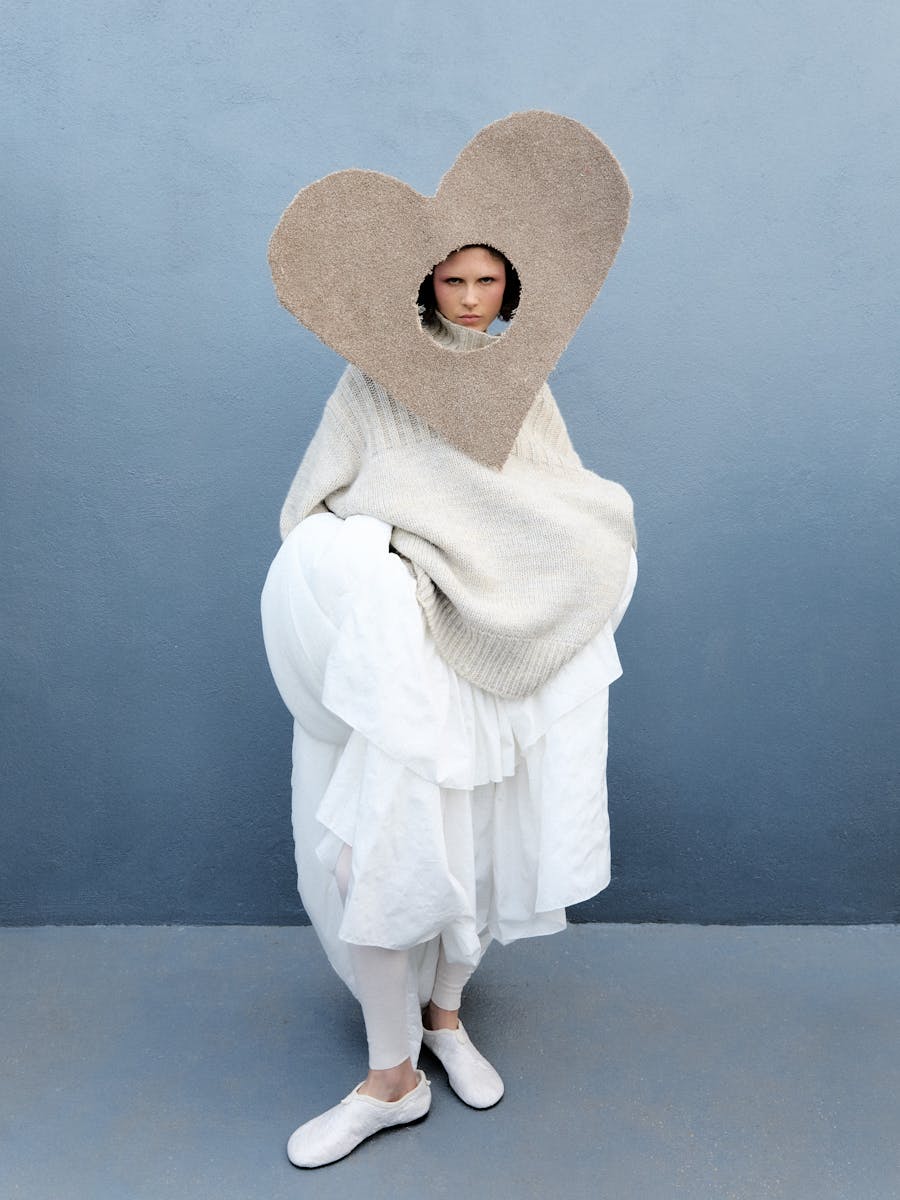
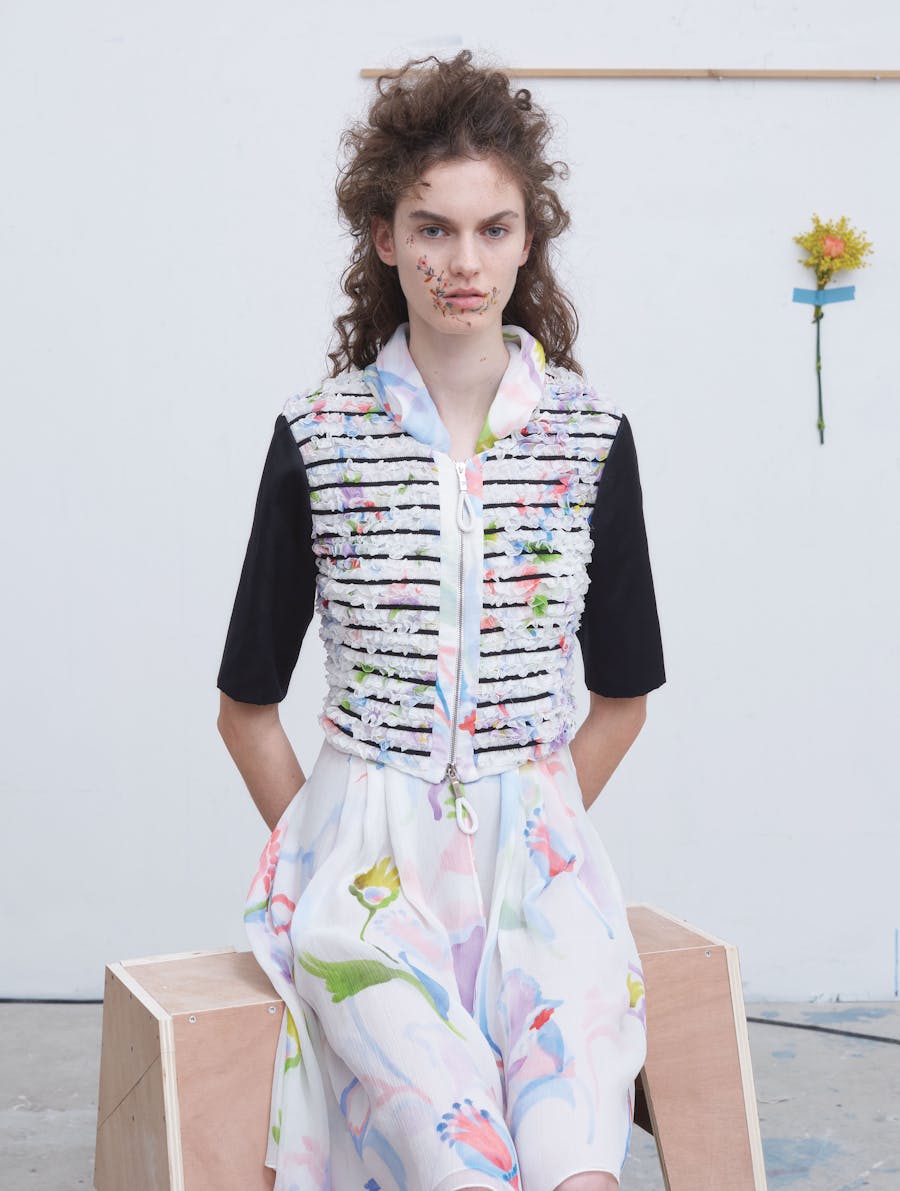
P.D. At its core, it’s about re-exploring traditional crafts and knitting techniques, giving these ancestral processes a contemporary, singular perspective. That means hand-knitting, but deconstructed: panels slashed apart, weaving set against crochet, hand-manipulated textiles layered almost like a 3D collage, mixed with metallic crochet jewellery and tulle ribbons running through the knit. Each textile is developed by hand first, then manipulated and draped onto the body, resulting in vaporous, feminine silhouettes that move rather than hold their shape, light and sensual even when the technique behind them is incredibly dense.
Knitwear has often been associated with tradition and domesticity. How did you want to redefine the way we perceive it today?
P.D. I’m a woman designing, with women, for women. The brand is built on memory, on honouring the women who came before me. I don’t try to escape the domestic association with knitwear, I try to correct what we assume it means, and celebrate the people who master it. Hand knitting is often seen as a hobby, something from the past, when to me it’s a skill that belongs to the present and the future. I want to show how technical, how beautiful this technique is, and the way it still fits within contemporary fashion as a unique form of expression, capable of extraordinary delicacy.
Can you walk us through your creative process?
P.D. It starts with a woman: the women of my family, the knitters we work with, our team, the women of theatre, literature, and cinema whose stories refuse to disappear. A collection usually begins there, with a story I can’t stop thinking about, often carried by songs I play on repeat until they shape the first colours and materials. Then comes stitch development and technique research with our artisans, before draping and exploring new volumes with the team, developing textiles, testing how a gesture someone has practiced for years can be pushed into something that hasn’t existed before. Closer to the show, it becomes about how the pieces are seen: styling to bring out the silhouettes in a new light, then casting, finding the women the story resonates with, asking whether they belong together. Those questions often tighten the collection as a whole.


Which figures have inspired you the most?
P.D. Francesca Woodman and Diane Arbus, both for that vulnerability they photograph without flinching. Nan Goldin too, for her need to capture the people she loved, to keep them close despite everything, an idea I keep coming back to. I love the visual worlds of Irina Ionesco and Tim Walker, so distinct, and then David Altmejd, Marta Bartuszowa, Ruth Asawa, whose plasticity, that soft, organic quality, is close to how I want to work with our collections. Lars von Trier and Sarah Kane are in there too, for how far they were willing to go into darkness and intimacy, for women pushed to their limits and still standing.
Your silhouettes are sensual, delicate, at times radical. How do you want women to feel in your clothes?
P.D. Special, considered, comfortable, like a new version of themselves. I want them to feel part of a community, creatives, makers, wearers, all connected through the piece they’re wearing. When we explain the craft behind each piece, customers often relate to it in a very personal way, a memory of someone they used to watch knitting, or knit alongside as a child. That’s exactly the connection I want the clothes to carry. I also want them to feel seen and respected, but never on display. More like the textile is an extension of their own sensitivity. Feminine, sensual, yet strong. Incisive.


Your work is deeply connected to women’s craftsmanship, from your grandmother’s knowledge to the female artisans you collaborate with today. How does this idea of transmission shape your practice?
P.D. Behind every garment there is a human hand. A skill passed down, a story that deserves attention. I hope to create an emotional bond between the wearer and their garment. Pieces people want to keep, repair, and maybe even pass on one day, rather than discard or forget. I hope to express my own sense of beauty, trying to turn violence and ugliness into a moment of poetry, or relief, in a world that often feels unbearable.
You’re planning a documentary to give more visibility to these women, their skills, their stories. Can you tell us more?
P.D. This is something I’ve wanted to do for a while, but the brand has been growing fast, and we’ve been too busy the past few seasons for me to get away from the studio. The plan is to go to Lima with my photographer to film our work with the knitters there, and winning the ANDAM Special Prize last July has made that even more possible. The goal isn’t to document a supply chain, it’s to change the narrative around what gets called domestic skills, to make visible the hands behind our textiles and who these women actually are, how they form a community and work together. It’s not a side project. It’s essential to who we are, and it matters to me that we show the intricacy of the clothes and the people who work on them so carefully and so patiently.
Looking ahead, what do you hope your work will leave behind?
P.D. I’ll forever go back to the image of my grandmother, hand-making for her loved ones. Without knowing it, she planted the seed that inspires me today to employ artisans around the world, to build independence through craftsmanship, and to dress women worldwide with a sense of singularity, sensitivity, and care.