Cynthia Merhej belongs to a generation of designers for whom craft is not nostalgia, but structure. For whom inheritance is not a constraint, but material. Raised in her mother’s atelier in Beirut, she grew up among fittings, fabric rolls, and the exacting discipline of couture. After studying visual communication at Central Saint Martins and the Royal College of Art, she returned to Beirut in 2016 to launch her label, rooting her practice where her lineage began. Working in collaboration with local artisans and family-run workshops, Renaissance Renaissance operates both as a fashion house and a commitment to place.
For the launch of Renaissance Renaissance SS26 at Dover Street Market Paris, we spoke with Cynthia Merhej about instinct, inheritance, and building a world on her own terms.
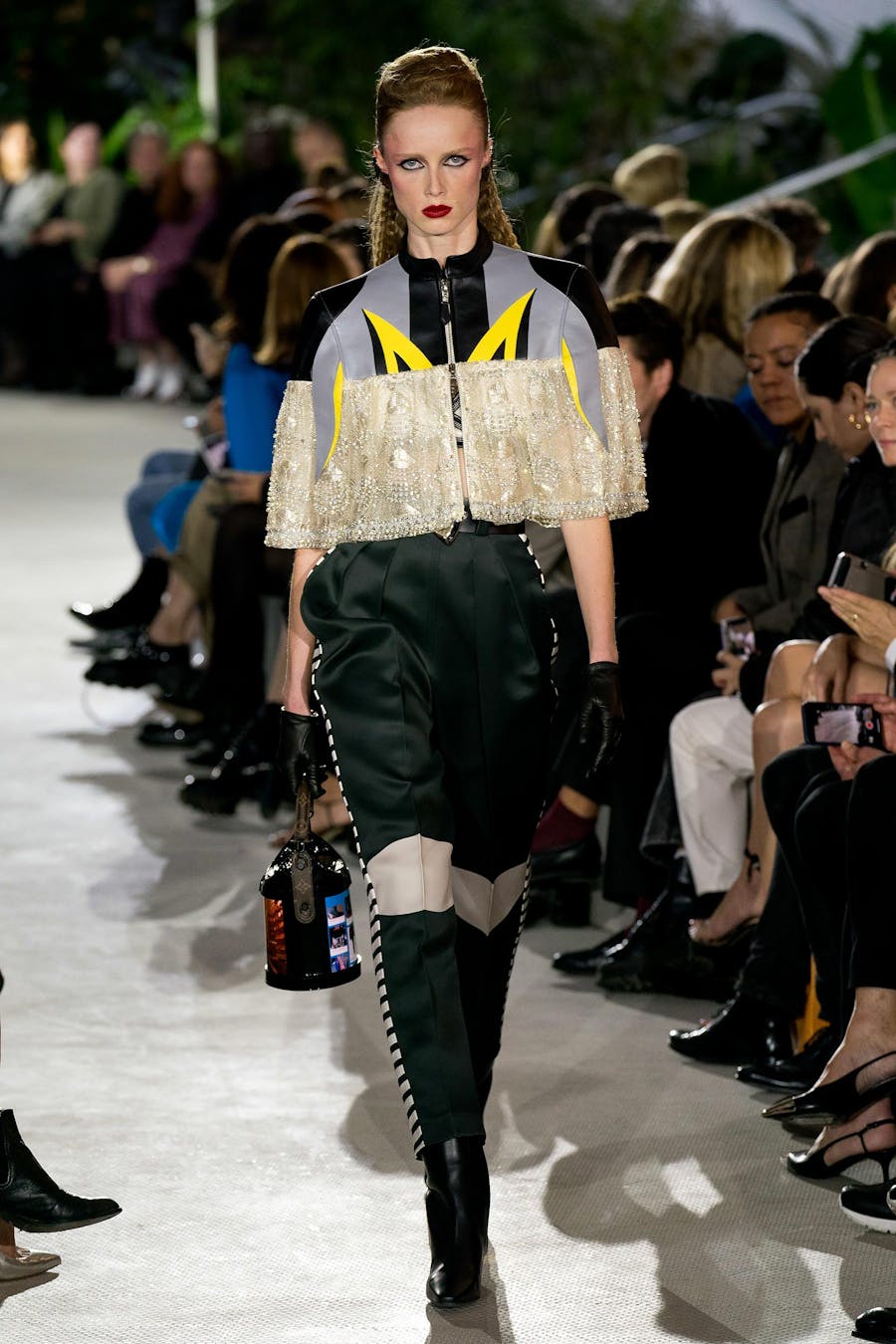
Since its inception, Renaissance Renaissance has redefined occasionwear. Tulle, bows, ruched drapery, and tailoring form its vocabulary, balancing fragility with control. Her silhouettes feel light, never naive. Romantic, yet sharpened by context. For Merhej, beauty and resistance are not opposites. They coexist.

Did you always want to become a fashion designer, or was there a defining moment when you knew this would be your path?
C.M. There wasn’t really any defining moment. Fashion was always there and such a big part of my life that I took it for granted. I was also excited about photography, music, film and art. I just didn’t know how to make it all come together when I was younger. The idea of what a fashion designer was felt quite limited until I went to university in London. That exposed me to a completely different world and got me excited about fashion. Even without studying it, I realized I could do it in my own way and build my own world.
After studying at Central Saint Martins and the Royal College of Art, you chose to return to Beirut to launch your brand. Why was it important for you to build Renaissance Renaissance from there?
C.M. Logistics, really. I wanted to be a creative director and start a brand. I couldn’t go anywhere, no visa and no money. So it seemed like the fastest way because I had resources and family there. I applied for jobs, got one, and that helped me support myself while rebuilding my network properly. I didn’t realise how important that decision was until later. I always had a difficult relationship with the country and a lot of trauma, so at first it felt practical rather than emotional. Now it’s a choice out of love, and I’m so grateful to create something from there, especially for the early support from my family and friends.
You are the third generation of couturiers in your family. How does that legacy shape your sense of responsibility, creatively and ethically? And how have you consciously carved a different path from your predecessors?
C.M. There is definitely a responsibility to maintain this legacy, the legacy of making women feel great and making clothes really well. It’s stressful because making clothes isn’t easy. It’s a craft more complicated than people think, and you keep learning every day. My mother has been doing this for almost 40 years and she’s still learning. Balancing that with my own vision, which is less traditional and more intuitive and experimental, is alchemical to say the least. When it comes together it’s magical. But aligning all the parts is a major feat every time, especially because our resources are so limited.
What have you had to unlearn from your family’s couture heritage?
C.M. Perfection is the bane of every artist’s existence. It doesn’t actually exist, yet it haunts us like a phantom. I’m much freer by nature. I know what I want, but I’m flexible about how we get there and open to something more interesting happening along the way. I’ll know if I like the end result. It’s either yes or no. I don’t get too attached to it. It’s very intuitive. My family works very differently. It’s much more linear. I also trust when I immediately know I won’t like something and don’t want to waste time on it, even if people want a rationale. It took years to unlearn that inherited linear way of thinking, becoming confident in my way of doing things, being ok in just trusting myself.
How does designing from a city that has endured instability shape your relationship to permanence?
C.M. It fundamentally shaped me, especially after 2019. It wasn’t a fun way to learn it, but you understand that life is fucking short. Things can change in a second. Your whole life can shift. You can’t control anything. Love is everything, maybe everything we have. Go after what you want. Enjoy every good second. I spent a lot of time being anxious. For what? It has allowed me to take more risks. I don’t want to waste time being nervous when things are going well. I’m willing to throw myself into the fire because seriously, fuck it, who knows how long this good thing will last?
Your brand operates between Beirut and Paris. How do these two cities influence your work differently?
C.M. They are very different but there are similarities. Beirut was under French mandate until the Second World War, and there was a lot of cultural exchange with Italy during the Ottoman period. So you have French, Italian and Ottoman influences mixed with a very distinct Arab identity. In Paris there is also a strong Arab presence, so there is a real confluence between the two places, which makes it easy to move between them. As a Lebanese person I’ve learned that I don’t exist in one place only, and I’m comfortable moving between different worlds. My identity isn’t shaped by a single place. Even in Lebanon it’s very diverse, and you are constantly navigating different cultures, although there it is often more religious. Both influence me, and I see it as one space I operate in.
Who is the Renaissance Renaissance woman? What does she desire, and what does she refuse?
C.M. I think she refuses to be boxed in. She desires to be sensual, to be free in her body, to be playful.
How do you want women to feel in your clothes : controlled, protected, exposed, sovereign?
C.M. Definitely not controlled or protected. I want the Renaissance Renaissance women to feel light, seductive, sensual, playful, like the center of the universe for a little while. Comforted too. Able to feel soft without negating their strength and intellect. To feel desired and to desire.
Your work moves between poetry and pragmatism, softness and structure, East and West. If you had to define the DNA of Renaissance Renaissance in three words, what would they be?
C.M. Poetic, sensual, playful.
Can you walk us through your creative process?
C.M. In no particular order, there is always writing. A lot of writing. A story. Gathering images and setting the tone with a story and storyboard. Scribbles and quick ideas in 3D. Starting to make things in 3D, playing with draping, styling and so on.
Which designers, artists or figures have influenced you the most? Do you have a style icon?
C.M. My style icons shift a lot and I can’t think of anyone off the top of my head right now. But there are so many designers and artists. A lot of female artists like Etel Adnan or Saloua Raouda Choucair. Filmmakers like Mohammad Soueid and Abbas Kiarostami. Maybe not as direct influences, but in terms of feeling and mood. The new generation of artists from our region is incredibly inspiring. In fashion, I go back to historical costume and the classics of the 50s like Cristóbal Balenciaga, then the 90s and 2000s with John Galliano, Junya Watanabe, Miuccia Prada. There is something to learn from all the greats. But I’m looking less at designers’ collections now and more at clothes in general. I’m more excited by clothes and stories than by collections. I sometimes feel like the idea of a collection is kind of dead.


You’ve spoken openly about structural bias in fashion, particularly as an Arab woman. How have those challenges shaped your resilience and ambition?
C.M. I don’t think it’s a secret to anyone working in fashion that it’s not a business that loves women or people of color. It’s a subject that comes up constantly when I speak with friends in the industry. There is always hope that things will truly change, but they won’t if we give up. Maybe that’s why many of the women designers we admire operated within their own businesses and were able to do pioneering work there, with a few exceptions. It has definitely shaped resilience and ambition in me. The more time passes, the more I realise that what I’m doing as a creative director feels needed. I’ve wanted to quit so many fucking times. Then someone tells you how much it means to them, and you think, ok, I can’t stop.
How do you protect your creative integrity while building a business?
C.M. The only thing you can do is be ready to be insulted by strangers.
Your latest collection, “La Touriste”, explores rest as a form of luxury. What feels truly aspirational to you today?
C.M. Rest still feels aspirational, and it’s something we need to learn to make time for. Being in touch with our bodies feels like a luxury. Being in touch with sensuality, instinct, fun, play. Spontaneity. Romance. Daydreaming. Sincerity. I think we’ve lost touch with that. The whole crazy wellness and longevity obsession feels symptomatic. Everything is so calculated and controlled. People are scared all the time. Being able to let your guard down is probably aspirational now.
The title suggests movement, yet the collection celebrates stillness. Is “La Touriste” traveling through the world, or through her inner landscape?
C.M. That’s exactly it. She’s a tourist in her own space. It’s about discovering your inner world as a completely new arena.
Looking ahead, what does the next chapter look like for you? How do you envision the future of Renaissance Renaissance?
C.M. I want to keep bringing more beauty into the world. More fun, more sensuality, more romance, more life. I also want to make things more accessible. At the end of the day, fashion is fun and it can make us feel good. I don’t want to deny anyone that feeling. Within the realm of my universe, whoever relates to it, welcome to the club!