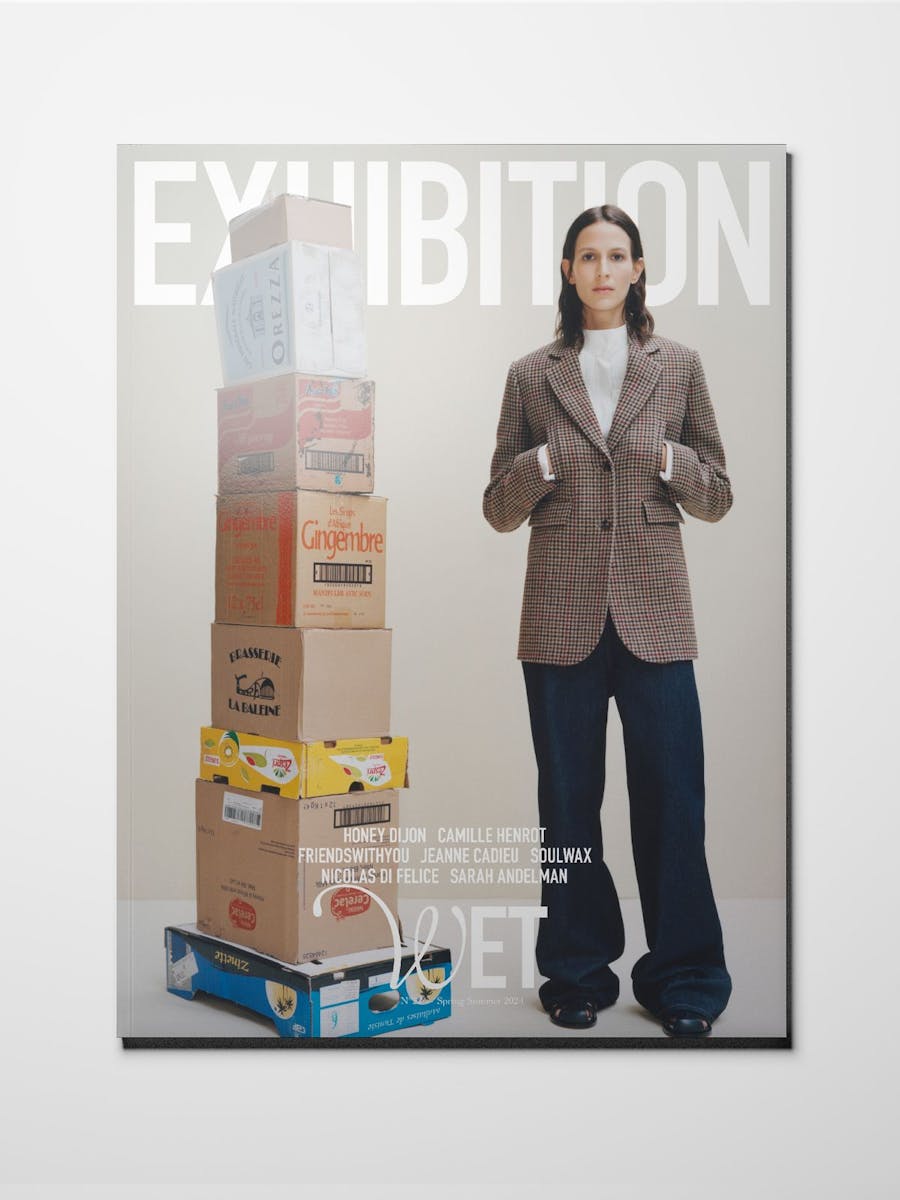
From the Room Issue
In 1963, the Beach Boys sang an ode to the room, a place to disappear, to plan, to pray. Whether it is a bedroom or a simple space, as evoked in In My Room, the idea remains the same: the dream of a separate place, removed from the rules of others. Like the white cube of an art gallery, the room is a neutral site where anything can be invented: physical, virtual, symbolic, or purely mental. Separated from the rest, it nevertheless remains open to infinity. Waiting room, newsroom, panic room, VIP room: its functions are as numerous as our desires. Yet the one most deeply rooted in the collective imagination is undoubtedly
the bedroom.
In literature, and even more so in cinema, the adolescent bedroom appears as a safe place, a territory into which others, especially adults, enter only with the consent of
the person concerned.
The French teen-movie La Boum by Claude Pinoteau fixed an emblematic image of the bedroom: on the door, a double-sided road sign—no entry on one side, free access on the other—and inside, with its white telephone and pop-culture fetish objects, a space that became a reference point in the adolescent imagination of the 1980s.
A few years later, in L’effrontée (1985) by Claude Miller, starring Charlotte Gainsbourg, the bedroom is presented as a refuge: a place where nascent desires are sheltered and where one absorbs the shocks of an unstable age, caught between joy and frustration.
This self-evident idea, the bedroom as an adolescent “Wunderkammer”, a cabinet of wonders where everything seems possible, also inspires artists.
Adrienne Salinger’s photobook Teenagers in Their Bedrooms (1995) was constructed through images chosen to reveal a double effect: the teenage bedroom triggers self-recognition (we have all been adolescents) and, at the same time, a certain voyeurism—especially among adults who revisit this period while feeling entirely foreign to what it now contains. Yet the adult gaze is not solely one of otherness.
It was at the dawn of a twentieth century already well underway toward the staging of intimacy by the media that Virginia Woolf, at forty-seven, published A Room of One’s Own. The book was received as a manifesto of privacy: the right for all women to construct an autonomous identity, sheltered from any gaze, masculine or otherwise. The text offers a lucid analysis of the female condition, as well as a central idea of modernity, the belief that the self is built in the most private of spaces, far from social injunctions and scrutiny.
By extension, the bedroom becomes the place of being, while the outside world, the public sphere, refers to appearance and to the roles we perform in order to obtain what we desire. Fashion is a direct expression of this: it organizes the transformation of appearance and adjusts our ways of being to social, seductive, and professional performances. This back-and-forth between a private cabinet of curiosities and the public stage is structuring, because it is difficult to inhabit only one of the two.
Even Dorian Gray, in Oscar Wilde’s novel, occasionally abandons the aura of worldly light in which he moves in order to secretly return to his former bedroom, where he hides the portrait that ages in his place. His fantasy of eternity fails because he believed that the intimate and the public could remain sealed off from one another.
By contrast, the books of Shiori Kawamoto, Daraku Room (2012) and Onago Room (2017), depict the interiors of Japanese otaku whose lives unfold far from social life, within bedrooms conceived as mirrors of their inner worlds. In these spaces overloaded with objects, colors, forms, and clothing, it becomes difficult to distinguish the individual from the setting, as if bodies were merging with spaces, and worn fashion with interior design.
This idea is less marginal than it might seem if one considers the exhibition Fashion & Interiors. A Gendered Affair at the MoMu in Antwerp (2025), which examined the cross-contaminations between fashion and interior design as two expressions of the same cultural identity.
In Histoire de chambres (Seuil, 2009), Michelle Perrot broadens the perspective on this phenomenon. She traces a cultural history of the bedroom in the West from Antiquity onward, showing how intimacy is constructed there, always in relation to class, gender, and power. The book defines the bedroom as a true “theatre of existence,” from childbirth to the final agony.
The symbolic scope of this place can even be read in the English expression “give room,” which literally means to make space. But it also advocates a social rule: not to obstruct, not to impose one’s presence, to respect distances, and to leave the other their autonomy. A political dimension can also be discerned here: the recognition of the legitimacy of difference and of each voice, as though conflicts might ultimately be more healthily neutralized through withdrawal than by surrendering to our unsinkable instinct for conquest.