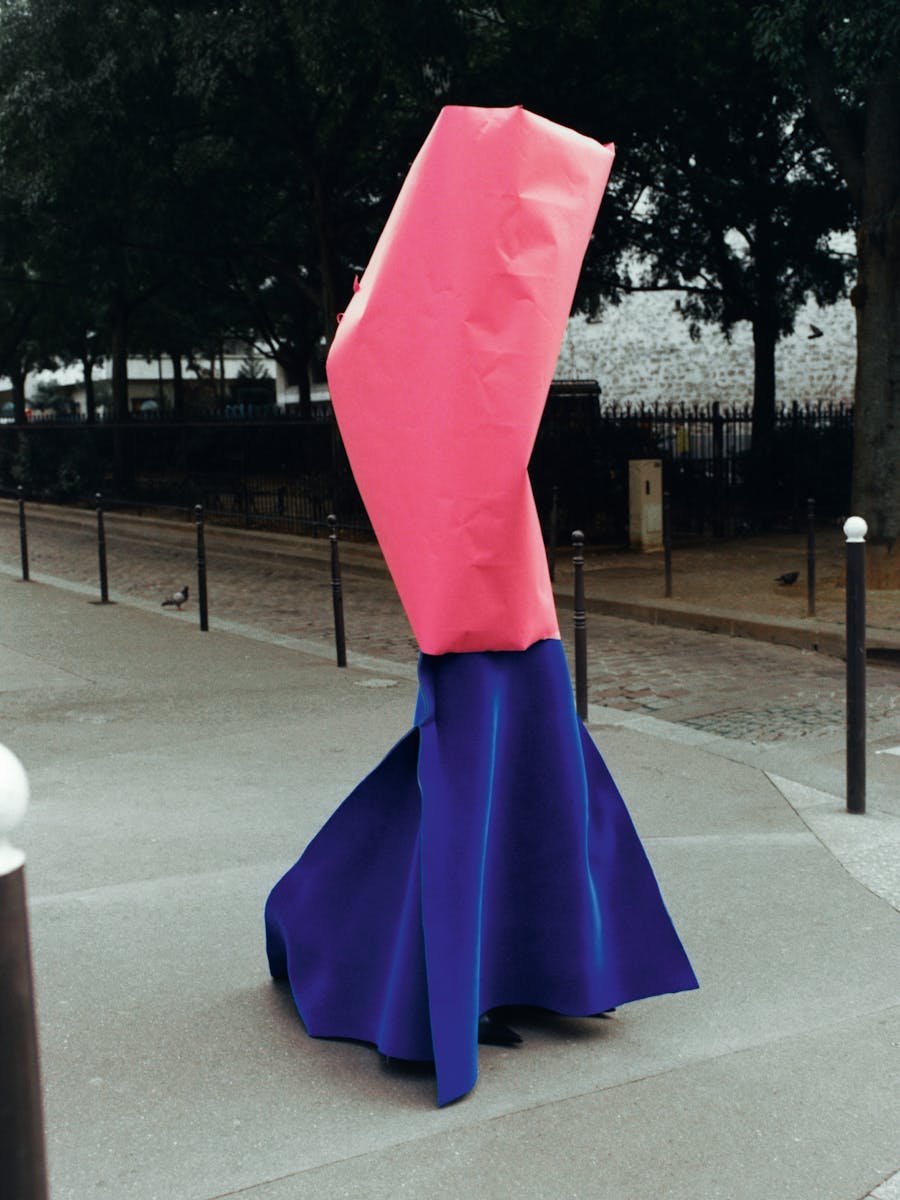
From The Stories Issue
Luxury is going through its most difficult phase since the turn of the millennium. The most intuitive response would no doubt be to reassert its original know-how, that of producers of manual excellence. And yet many of the sector's great names seem less attached to their artisanal history than to the stories they can tell by aligning themselves with cinema and streaming series. A strategy that has something surprising about it.
Even a heritage institution like Louis Vuitton makes no secret of its ambition to produce great cultural narratives as much as garments and accessories, aligning itself more than ever with major figures from the world of pop culture.
Since, in commerce, nothing happens by chance, should we conclude that the era in which all-out craftsmanship was brandished as the sector's keystone is already over? That the aura of desirability generated by audiovisual storytelling has now surpassed that of the exclusive purchase?
Among the detractors of this hypothesis is the writer and researcher Christian Salmon, who warns against the current overdose of collective narratives. In Storytelling, he denounces the way in which, within the media nebula, everything becomes narrative, severed from any relation to lived context. The consequence is a narrative economy in which it becomes extremely easy to steer the behaviour of millions of individuals, by broadcasting stories whose adequacy to reality no one can any longer measure, nor distinguish the true from the false.
This reflection belongs to an even broader debate, one that goes as far as conceiving of humanity's future in terms of stories, as a struggle between competing imaginaries. In this view, the reins of the world would be held by the most powerful narratives.
This is also the position of Alain Damasio, a science-fiction author elevated to the status of pop-culture guru by his Gen Z readership. In a recent debate on "cultural imaginaries," he defended the crucial role that these great collective narratives play in the destiny of the world, becoming planetary in a very short time thanks to hyper-mediatisation.
If "imaginaries" are so effective, it is because they are not necessarily Histories with a capital H, official versions of established facts, but hybrid narratives, made partly of real experience and, to a very large extent, of beliefs, inventions and symbols. They do not form only on a global scale: they begin to take shape in the infinitesimal, in the micro-narratives we write daily, by consuming and posting images on social media, or by desiring, buying and wearing clothes. This is how we sketch out the character of ourselves, within a story co-written with everyone around us.
It is from this collective fabric that brands, too, draw. To the subtle link between fashion and narrative, Bruno Remaury devoted the prescient essay Marques et récits (2004), showing that "inside" every house endowed with a powerful imaginary lies a story just as compelling. The story that houses tell is not merely a commercial artifice: it is also the lever of belief and desire that, over time, has raised them well above the status of "brand," turning them into genuine pillars of popular culture. Along the same lines, Emanuela Mora and Marco Pedroni, in Fashion Tales: Feeding the Imaginary (2017), studied style as a support for individual identity and as raw material for the collective narratives through which communities consolidate themselves, within the urban fabric as much as in global culture.
Such an everyday mythology, on one hand, provides the tools to insert oneself into social life; on the other, it allows one to escape a reality that bores, frightens or alienates because it is deprived of meaning. It has been noted a thousand times over: the enchanting power of the stories broadcast by mass media, or the glittering dreams produced by advertising, can be perceived as so much more desirable than reality that they end up making us forget it.
The society of overproduction and the culture of hyper-consumption have markedly reinforced this tendency, for instance by programming the obsolescence of style through continuous drops, which re-dress products already available, or through the escalation of limited-edition collabs, which has caused speculation on online resale to explode. The market is now so saturated that it can no longer seduce simply by offering new products.
In a system that the speed of turnover and the dematerialisation of purchase threaten to implode, telling the story of the brand, or of the product, then becomes a precious tool for revealing the implicit value of collections and recreating meaning around them.
Living without stories is impossible, for a brand as much as for individuals. Both share a narrative nature. But living on stories alone is madness. Whether it concerns human destinies or garments, the magic of the stories they tell is born of their contact, more or less close, with the world and with lived experience. No doubt, one cannot draw a clean line of demarcation between stories and reality. After all, reality seems enchanting to us because it tells us infinite stories, and if humanity has always told them, it is not to conceal reality behind narrative, but to understand it better. It is our way of giving meaning to experience, the best one we have found for inhabiting the world.